Climate control built around how your business works
Commercial premises rarely behave like homes. A busy salon, a gym floor at peak time or a restaurant mid-service can throw out far more heat than the building alone would suggest. A stockroom or comms cupboard, on the other hand, may need cooling for completely different reasons. Getting the system right starts with understanding those loads.
Teesside Air Conditioning designs and installs systems for businesses of all sizes, from a single-unit shop to larger multi-zone premises. We survey the site and ask about occupancy, opening hours and equipment. Then we recommend a system type and layout that suits the building, rather than quoting the biggest unit that will fit.
We can plan the work around your trading, arrange servicing and help you understand your obligations as an equipment operator. Every project begins with a free site survey and a clear, no-obligation written quote.
- Premises
- Retail, hospitality, leisure and industrial
- System types
- Wall, cassette, ducted and VRF/VRV
- Scheduling
- Out-of-hours work by arrangement
- Survey and quote
- Free site survey, written quote
Air conditioning for different types of premises
Every sector has its own pattern of heat, occupancy and appearance, and we factor that in from the first conversation.
Retail and hospitality
Shops with display lighting and big windows, cafés with coffee machines and restaurants with a busy front of house all build up heat through the day. Customers notice a stuffy room quickly. Staff on long shifts notice it even more. Discreet ceiling or wall units, placed so the air doesn't blast tables or tills, keep things pleasant without taking over the décor.
Salons, gyms and studios
Hairdryers, straighteners and treatment equipment make salons surprisingly warm. Gyms and fitness studios pair high occupancy with hard physical exercise. Both often need more cooling capacity than the floor area suggests, and the airflow has to be planned so clients aren't sat in a draught.
Warehouses, workshops and trade counters
Large open buildings on Teesside's industrial estates are rarely suited to cooling the whole volume. It's usually more practical to treat the areas where people actually work, such as offices, trade counters, mezzanine stations and break rooms, and look at ventilation and spot cooling for the rest.
Why the right system pays off for a business
Comfortable customers
A pleasant indoor temperature encourages people to stay, browse and come back.
Better working conditions
Staff on long shifts in warm salons, kitchens or shops can work in comfort.
Protected equipment
Dedicated cooling helps keep comms rooms and sensitive stock at safe temperatures.
Heating included
Most systems are reverse-cycle, so the same equipment gives efficient heat in winter.
Minimal disruption
We can phase the installation or work out of hours so you keep trading.
Clear advice on obligations
We explain your maintenance and refrigerant responsibilities in plain terms.
Server and comms rooms: close control or comfort cooling?
Small comms cupboards and server rooms run round the clock and turn almost all of their electrical load into heat. Plenty of smaller sites use a dedicated comfort cooling split system for this. It needs to be rated for continuous running and able to cool when it's cold outside. For a modest rack, that's often a sensible, cost-effective choice.
Larger or more critical rooms may justify close control units. These hold both temperature and humidity within tight limits and are built for 24-hour duty. Whichever way you go, think about redundancy (a second unit that takes over if the first fails) and an alarm that tells someone if the room starts to overheat.
- Ask what IT equipment is installed and roughly how much power it draws
- Check whether the unit is rated for low-ambient cooling in winter
- Consider a duty/standby arrangement for important equipment
- Keep the room sealed from other spaces so cooling stays efficient
Commercial system types and where they fit
The right indoor unit depends on the ceiling, the layout and the look you're after. We'll be honest about the trade-offs so you can choose with confidence.
Indoor unit options
Each style suits different buildings, and many premises end up with a mix.
Wall-mounted units
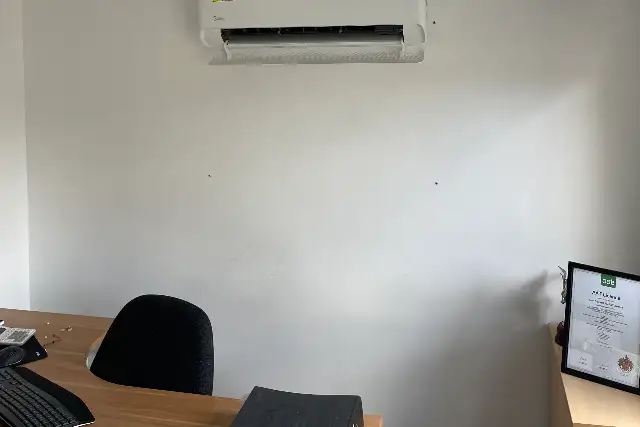
Simple and cost-effective for smaller shops, back offices and stockrooms with suitable wall space.
Ceiling cassettes
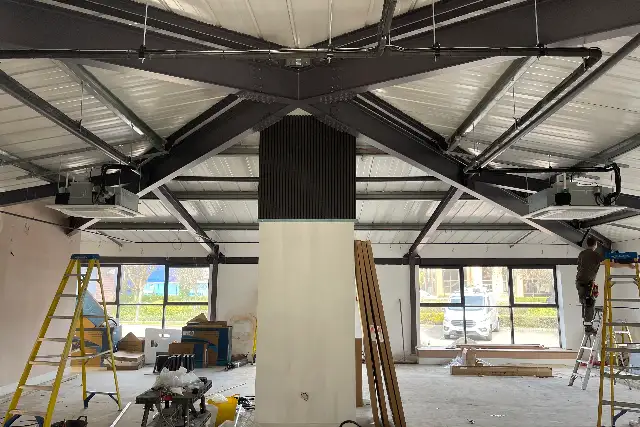
These fit into a suspended ceiling grid and push air in several directions, leaving walls clear for displays.
Ducted units
Hidden above the ceiling with only grilles on show. Ideal where looks matter or one unit needs to serve several areas.
Under-ceiling units
A practical option where there's no ceiling void, such as a shop or workshop office with a solid ceiling.
What is a VRF or VRV system?
Variable refrigerant flow (VRF), which one manufacturer calls VRV, links many indoor units to one or more outdoor units and varies the refrigerant sent to each zone as demand changes. Some VRF systems can heat some zones while cooling others. They suit larger multi-zone buildings, but designing one is a serious piece of work. Smaller sites are often better off with individual splits or a multi-split system.
What shapes the cost of a commercial installation?
Commercial projects vary hugely, from one wall unit in a shop to a multi-zone system over several floors, so we don't publish prices. Each quote is based on what we find on site and what your business needs. Local firms come to Teesside Air Conditioning for exactly that kind of site-specific advice.
After a free survey we send a written quotation setting out the equipment, the scope of work and any assumptions. That makes it easy to compare like for like and plan your budget.
Heat load and capacity
Occupancy, equipment and glazing set the kW capacity needed, and that drives equipment cost.
System type
Wall units, cassettes, ducted systems and VRF all differ in equipment cost and how complex they are to install.
Building and access
Ceiling voids, roof access, long pipe runs and the need for lifting gear all affect labour.
Working hours
Phased or out-of-hours work that keeps you trading takes more planning and can affect the overall price.
Electrical and controls
Dedicated supplies, central controllers and links to building management systems add to the scope.
Running costs
Operating hours, set points, maintenance and the efficiency of the equipment you choose all affect ongoing energy use.
Sizing starts with the heat load
You can't judge commercial capacity by floor area alone. Every person adds heat. So does almost everything that runs on electricity: lighting, ovens, fridges with remote condensers, computers, hairdryers, treadmills. On a sunny afternoon, solar gain through a glazed shopfront can add a lot more. If your premises include a separate office suite, our page on office air conditioning covers zoning for desks and meeting rooms.
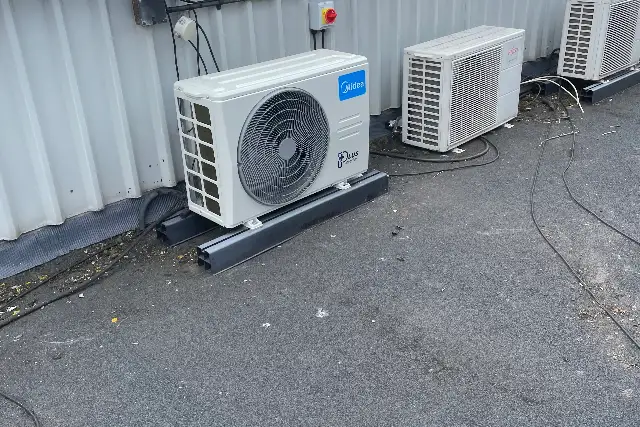
At survey we collect what's needed to estimate those loads properly, including typical and peak occupancy, opening hours, equipment lists, glazing and orientation. An undersized system runs flat out and still falls short on the busiest days. An oversized one costs more to buy and can cycle inefficiently. We see a wide mix of sites across Teesside and the surrounding areas, and exposed spots near the coast at Redcar or Hartlepool affect where outdoor units go and whether coastal-grade protection is worth specifying.
Installation, maintenance and F-Gas responsibilities
We know downtime costs money. Installation can usually be done in phases, and we can arrange out-of-hours or weekend working so the noisy, disruptive jobs happen while you're closed.
Can installation be done outside trading hours?
Often, yes, by prior arrangement. We agree the programme with you before work starts, including which areas are affected and when, so you can plan around it.
Why planned maintenance matters
Commercial systems tend to run for long hours, so filters clog and coils get dirty faster than they do at home. Regular planned maintenance helps keep efficiency up, cuts the risk of a breakdown in your busiest weeks and supports manufacturer warranty conditions.
Do F-Gas rules apply to my business?
If you operate equipment containing fluorinated refrigerants, you have legal responsibilities. Depending on the type and amount of refrigerant, these may include periodic leak checks and record-keeping. Work on refrigerant circuits must be done by suitably certified engineers, so ask any contractor for proof. The requirements can change, so check current guidance for your own equipment.