What is a split system and why is it so popular?
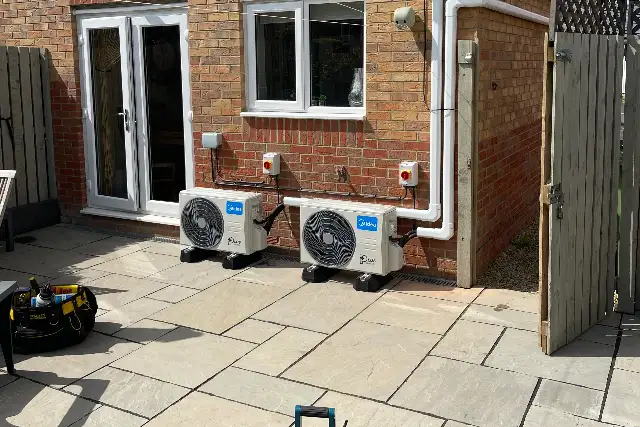
A split system divides an air conditioner into two parts. The noisy parts that get rid of heat (the compressor, condenser coil and outdoor fan) sit outside the building. Inside the room you have the indoor unit, which holds a coil, a quiet fan and a filter. A pair of insulated copper refrigerant pipes, a control cable and a condensate drain link the two.
Splitting things up this way is why these systems are so much quieter and more effective than portable units. They're the usual choice for bedrooms, lounges, home offices, server cupboards, shops and small offices. Most modern models are reversible too, so they heat efficiently in winter as well as cooling in summer.
Teesside Air Conditioning designs and installs single split systems for domestic and commercial customers. We've worked in everything from Victorian terraces in Middlesbrough to new-build homes in Ingleby Barwick. Every job starts with a free survey, and we size the system properly for the room and explain each choice clearly.
- Typical installation
- Usually 1 day per single-room system
- Configuration
- One indoor unit, one outdoor unit
- Common refrigerant
- R32 on most new models
- Wall opening
- Usually one small core hole
How a split system moves heat out of a room
Air conditioning doesn't make cold. It moves heat from one place to another. Refrigerant travels round a sealed loop between the indoor and outdoor units, switching between liquid and gas as it goes, and those changes let it soak up heat in one spot and let it go in another.
The refrigerant cycle in four steps
In cooling mode the cycle works like this. For heating, a reversing valve swaps the jobs of the two coils, so heat is collected outdoors and released indoors.
Evaporator: collecting heat indoors
Cold, low-pressure refrigerant flows through the indoor coil. Room air blown across it gives up its heat and the refrigerant evaporates into a gas. Moisture condenses out of the air at the same time and drains away.
Compressor: raising the pressure
The gas moves to the outdoor unit, where the compressor squeezes it into a hot, high-pressure gas. This is the part that uses most of the electricity.
Condenser: releasing heat outside
The hot gas passes through the outdoor coil while the fan blows outside air over it. It loses its heat and turns back into a liquid.
Expansion valve: resetting the cycle
The liquid goes through an expansion device that drops its pressure and temperature sharply. It's then ready to head back to the indoor coil and pick up more heat.
Why inverter compressors matter
Older fixed-speed systems controlled the temperature by switching the compressor fully on and off. An inverter compressor changes speed to match demand. It works hard to bring a hot room down, then eases back and ticks over. You get steadier temperatures, less noise and usually lower running costs. Efficiency is shown as SEER for cooling and SCOP for heating, and higher figures mean more output for each unit of electricity.
Why a single split system works so well
Quiet inside the room
With the compressor outside, the indoor unit makes little more than a soft rush of air.
Cooling and heating in one
Reversible models give efficient heat pump warmth in winter as well as cooling in summer.
Inverter efficiency
Variable-speed compressors match their output to demand, which helps keep running costs down.
Minimal building work
Installation usually needs just one small hole through the wall for the pipework, cable and drain.
A style for every room
Wall, floor, cassette and ducted units suit very different rooms and interiors.
Completely independent
Each system runs on its own, so a fault in one room never affects another.
Wall, floor and ceiling indoor units compared
The outdoor unit does the heavy lifting, but the indoor unit is the bit you live with. Which style is right depends on the room, the ceiling and where the air needs to go.
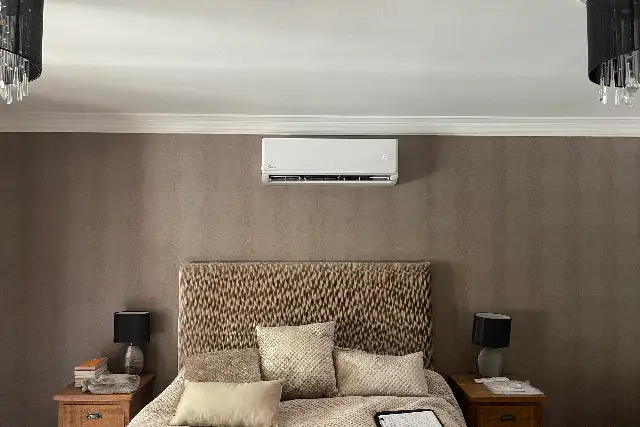
- High wall units: the most common choice and usually the cheapest, ideal for bedrooms, living rooms and small offices
- Floor-standing and console units: sit low down, handy under windows, in loft rooms with sloping ceilings and in conservatories
- Ceiling cassettes: recessed into a suspended ceiling and spreading air in several directions, popular in shops, salons and open-plan offices
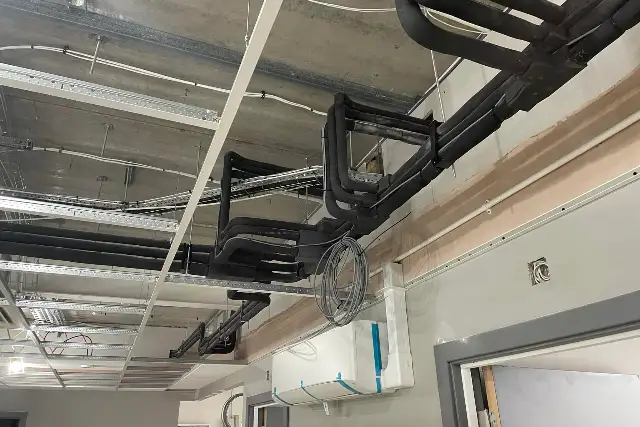
- Ducted units: hidden in a ceiling void so only the grilles show, suited to some commercial fit-outs and new builds with room to take them
Capacity sizing: getting the kW right
Capacity is given in kilowatts (kW), and sometimes in BTU per hour. Domestic rooms commonly use units of around 2.5 kW to 3.5 kW, while bigger rooms and commercial spaces need more. Rules of thumb based only on floor area often get it wrong, though.
Fit a unit that's too small and it runs flat out and still struggles on hot afternoons. One that's too big costs more to buy and may switch on and off too often, so it never runs long enough to take the moisture out and the room feels clammy. We work out the capacity from the room itself.
What we look at when sizing a room
- Floor area, ceiling height and how many external walls there are
- Window size, orientation and how much direct sun the room gets
- Insulation, since a solid-walled terrace behaves very differently from a modern new build
- Heat given off by people, computers, kitchen equipment or lighting
- Whether winter heating performance is a priority
What affects the price of a split system installation?
We don't publish set prices, because no two installations are quite alike. The biggest influences are the unit's capacity and style, and how easy it is to route the pipework and fix the outdoor unit. Book a free survey and we'll give you an accurate written quote with no obligation.
Running costs depend on how much you use the system, your electricity tariff, how well the room is insulated and the unit's SEER and SCOP ratings. Set to a sensible temperature, inverter models are typically economical to run for both cooling and heating.
Capacity and efficiency rating
Higher-output units, and models with premium efficiency or extra features, cost more to buy.
Indoor unit style
High wall units are usually the cheapest. Floor-standing, cassette and ducted units involve more equipment and more work.
Pipe run length and route
Long runs, extra refrigerant, trunking or going through several walls add materials and labour.
Outdoor unit mounting and access
Brackets at height, ground stands, anti-vibration mounts or coastal protection all affect the total.
Electrical connection
A dedicated supply from the consumer unit is usually needed, and the work involved varies by property.
Pipe runs and outdoor unit placement
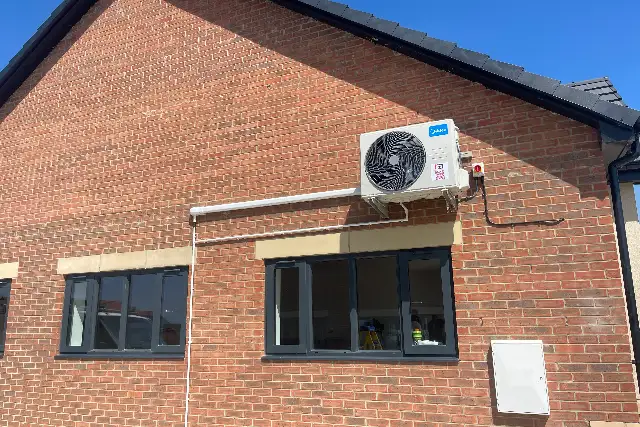
Every model has manufacturer limits on the longest pipe run between the indoor and outdoor units and the biggest height difference between them. Typical domestic units allow a reasonable run, and many come pre-charged with enough refrigerant for a set length. Longer runs may need extra refrigerant. As a rule, a shorter and simpler route is better for efficiency and cost, and planning that route is a big part of how Teesside Air Conditioning approaches every installation.
Where should the outdoor unit go?
The outdoor unit needs free airflow around it, a solid wall bracket or ground stand, access for servicing and a sensible distance from the neighbours' windows so the noise stays considerate. Noise levels are listed in dB(A) on the specification sheet, and we factor them in when choosing a spot.
Near the coast in places like Redcar and Hartlepool, sheltering the unit from direct sea spray and considering coastal-grade protection helps limit corrosion. In conservation areas, including parts of Yarm, a less visible position may matter more. We deal with all of these situations across Teesside and the surrounding areas, and if you're unsure whether you need permission, check with your local planning authority.
When is a single split the best option?
A single split is ideal for one room or one open-plan area. Each system works entirely on its own, so a fault in one room never affects another, and the controls couldn't be simpler. For a bedroom, home office, conservatory or single shop floor, it's usually the most straightforward choice.
To cover several rooms, you can fit several single splits or connect a number of indoor units to one outdoor unit with a multi-split system. We'll compare both honestly. Single splits are also a popular choice for bedroom air conditioning, where quiet running at night matters most.
How does a split compare with a portable or monoblock unit?
Portable air conditioners keep the compressor in the room and push hot air out through a flexible hose, usually via a window left ajar. That makes them noisy, less efficient and awkward to live with. Through-the-wall monoblock units do away with the outdoor unit, but they need two larger holes in the wall and are generally louder indoors. A split system costs more to install. It's also quieter, more efficient and built for everyday use over many years.