Home air conditioning that earns its place all year
Plenty of people in the North East still think of air conditioning as something for a few hot days in July. A modern reverse-cycle system does a lot more than that. It cools when the weather warms up, and in winter it runs as an air-to-air heat pump, so you get quick, controllable heat in the rooms that need it most.
Teesside Air Conditioning helps homeowners and tenants pick a system that actually suits their property. We look at how each room is used, which way it faces and how much glass it has. We check how well it holds heat, and where the indoor and outdoor units can go without spoiling the look of the house or bothering the neighbours.
You might want a single split system in a home office, or several rooms served from one outdoor unit. Either way we explain the options in plain English and give you a free, no-obligation written quote. If air conditioning isn't the right answer for your home, we'll tell you.
- Typical install time
- Usually 1 day for a single room
- Modes
- Cooling, heating, dehumidifying and fan
- Servicing
- Annual service generally recommended
- Survey and quote
- Free and no-obligation
Which rooms benefit most from air conditioning?
Not every room needs treating, and most households start with one or two problem spaces. The biggest gains usually come in rooms that soak up heat during the day, or ones the central heating never quite reaches.
Rooms that overheat in summer
South- and west-facing rooms with big windows can get far too warm on sunny afternoons, even when it's mild outside. Recent North East summers have brought more of those days, and they're often what gets people ringing us.
Bedrooms and loft rooms
Heat rises and sits under the roof, so top-floor rooms can be hard to sleep in. Our bedroom air conditioning page covers this in detail.
Home offices
A laptop, a couple of monitors and a closed door can turn a box room into a hot spot by mid-afternoon.
Extensions and kitchen-diners
Roof lanterns, bi-fold doors and cooking appliances add heat that the rest of the house doesn't feel.
Rooms that are hard to heat
North-facing rooms, converted garages, garden rooms and extensions built off the main heating circuit are common candidates. A reverse-cycle unit warms these spaces quickly, and you don't have to run the heating for the whole house just to take the chill off one room.
What a well-planned home system gives you
Comfort in every season
Reverse-cycle units cool in summer and give efficient heat-pump warmth when the weather turns cold.
Room-by-room control
Treat the rooms that need it without heating or cooling the whole house.
Quiet day and night
Low-noise indoor units and quiet modes suit living rooms, studies and bedrooms.
Drier, filtered air
Cooling takes moisture out of the air on muggy days, and built-in filters catch dust.
Discreet installation
We agree unit positions and pipe routes at survey, so the finished job looks planned rather than bolted on.
Straight answers
We'll tell you what will work in your home, including when it isn't worth doing.
Air-to-air heat pump heating explained
Most domestic wall-mounted systems sold today are reverse-cycle. In heating mode the refrigerant circuit runs backwards. The outdoor unit pulls heat out of the outside air (even on cold days) and the indoor unit releases it into the room. Because the system moves heat rather than making it, it can deliver more heat energy than the electricity it uses. That ratio is the coefficient of performance (COP), and the seasonal figure is published as SCOP.
Efficiency does drop as it gets colder outside. In frosty weather the outdoor unit will also run a short defrost cycle now and then, and heat output pauses briefly while it does. That's normal. In most Teesside homes an air-to-air system works best alongside the existing central heating, looking after the rooms where it makes most sense rather than replacing everything at once.
- Heats quickly, which suits rooms used at set times such as a study or guest room
- Room-by-room control instead of heating the whole house
- Doesn't provide hot water, as it heats and cools air only
- Not the same as an air-to-water heat pump, which connects to radiators
Quiet units, neat placement and a tidy finish
In a good home installation you notice the comfort, not the equipment. Indoor units from reputable manufacturers are built to run quietly, and their published sound levels in dB(A) are usually lowest on the quiet or night fan setting. Position matters just as much as the spec. Air shouldn't blow straight onto a sofa or dining table, and pipework should be hidden as far as the building allows.
Indoor unit styles
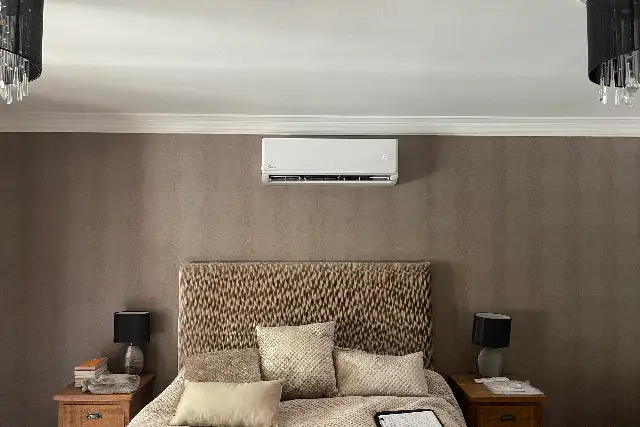
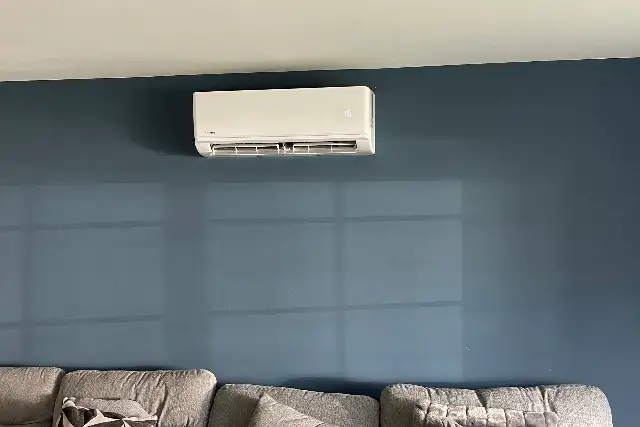
Wall-mounted units are the most popular choice. They come in a range of sizes and finishes, and some are designed to look more like furniture than kit. Floor-standing consoles work well in rooms with low walls, sloping ceilings or space under a window.
Where does the outdoor unit go?
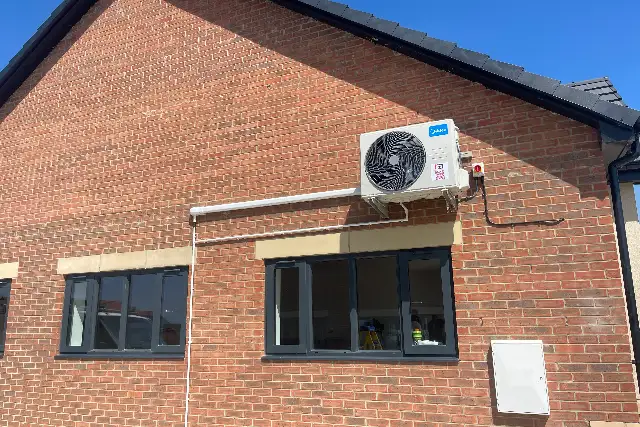
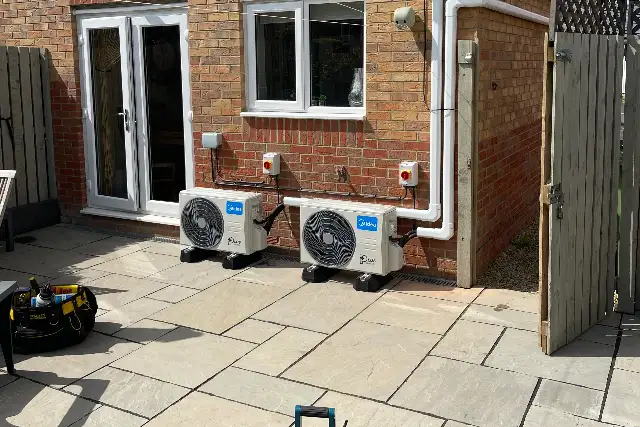
Outdoor units are usually fixed to the wall on brackets or set on a ground stand. We think about neighbours' windows, access for servicing, condensate drainage and how it looks from the street. Near the coast in Redcar, Saltburn or Hartlepool, salt-laden wind is a factor too, so we may suggest a sheltered spot or a unit with a coastal-grade protective coating.
What affects the cost of home air conditioning?
We don't publish set prices because no two homes are the same. The price of an installation comes down to the equipment chosen and the work needed to fit it properly. Running costs depend on how you use the system and what you pay for electricity.
After a free survey, Teesside Air Conditioning will send you a clear written quote showing exactly what's included. We're also happy to talk through the things that affect running costs, so you can decide with all the facts in front of you.
Number of rooms
One room on a single split is the simplest set-up. Several rooms may suit a multi-split system or separate units.
Capacity and efficiency
Units are rated in kW (or BTU). Models with better SEER and SCOP ratings can cost more to buy but less to run.
Pipe run and access
Longer pipe routes, trunking, boxing-in and work at height all take more time than a back-to-back installation.
Electrical supply
Larger units or several systems may need a dedicated circuit from your consumer unit, fitted by a qualified electrician.
Running costs
These depend on your tariff, your insulation, the temperatures you set and how many hours the system runs. A correctly sized inverter unit helps.
Different Teesside homes, different approaches
The house itself shapes the job. We plan pipe routes, unit positions and electrical connections around what we find at survey, rather than assuming one method suits every property. That's how we work on homes across Teesside and the surrounding areas, from Victorian terraces to brand-new estates.
Terraces and older properties
Victorian and Edwardian terraces in Middlesbrough and Stockton often have thick solid brick walls, little front access and small back yards. Sometimes the pipework has to travel through the house to reach a sensible outdoor position. When it does, we keep it neat and box it in where needed.
Semis, new-builds and bungalows
Semis usually have a side or rear wall for the outdoor unit, which keeps pipe runs short. Newer homes on estates such as Ingleby Barwick are well insulated and often need less capacity than people expect, although some come with restrictive covenants worth checking. Bungalows can be simple, and the loft is sometimes handy for running pipework between rooms.
Do I need permission from a landlord or freeholder?
If you rent, you'll need your landlord's written consent before any work starts. Leaseholders in flats or managed developments usually need the freeholder or management company to agree, because external walls are rarely part of the lease. Many houses can have an outdoor unit under permitted development, subject to conditions. The rules are different for listed buildings and conservation areas, such as parts of Yarm, so check with your local planning authority if you're unsure.
Smart controls and Wi-Fi apps
Every system comes with a handheld remote for temperature, fan speed, mode and timers. Many current models also offer Wi-Fi control, built in or through an add-on adapter. You can switch a room on from your phone on the way home, set weekly schedules or check you remembered to turn it off.
Features vary between manufacturers and models, so if app control matters to you we'll make sure the equipment we quote has it. At handover we show you how the controls work, including eco and quiet modes. If you're also weighing up other work, such as servicing an older unit, have a look at our full range of air conditioning services.